
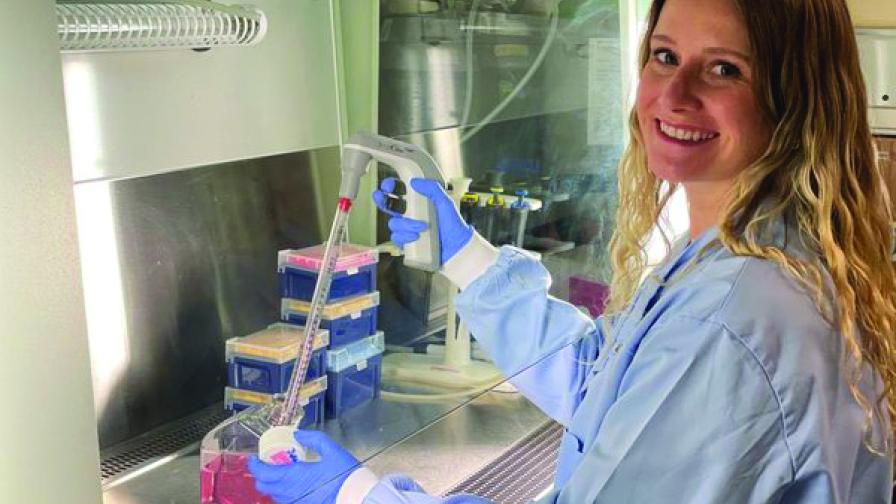
Borne and Action Medical Research spotlight Dr Ashley Boyle’s research into infection-associated premature birth as they mark 10 years of jointly funding research.
Borne and Action Medical Research are highlighting the impact of research they have jointly funded over the last decade to improve understanding of premature birth and help give more babies the best possible start in life.
Over the last eight years, Dr Ashley Boyle has worked across two Borne and Action Medical Research funded projects investigating antimicrobial therapy as a potential way to prevent infection-associated premature birth. The funding has not only enabled the research to progress from initial discovery science towards potential clinical application but supported Dr Boyle’s own development from a research fellow to an independent lecturer at King’s College London, where she is developing her own research programme investigating preterm birth.
Each year, around 55,000 babies are born prematurely in the UK and sadly, more than 1,000 babies die each year after being born too soon. Those who survive can face lifelong challenges including cerebral palsy, blindness, hearing loss and learning difficulties.
Evidence suggests that infection plays an important role in many cases of spontaneous preterm labour, with bacteria (also known as microbes) sometimes passing from the vagina through the cervix (the neck of the womb) into the womb, triggering inflammation that can lead to early labour and injury to the developing fetal brain.
Dr Ashley Boyle, Professors Simon Waddington and Donald Peebles are developing a novel antimicrobial therapy that aims to boost the body’s natural defences against infection. If successful, this could ultimately help prevent preterm labour in women at high risk of giving birth too soon; improving survival and quality of life for their babies.
Dr Ashley Boyle and the teams at UCL have benefitted from funding across two projects jointly funded by Borne and Action Medical Research to a total value of £386,663 between 2018 and 2026. Their aim was to develop a new treatment that can help prevent bacteria getting into the womb, thus delaying the onset of early labour. Anti-bacterial molecules produced in the cervix help to stop bacteria from getting through. The research team are developing a new antimicrobial gene therapy that is designed to boost these natural defences, helping to protect the womb from infection.
During the first Borne Action project Dr Boyle worked as a research fellow to investigate the role of vaginal bacteria, particularly strains of Escherichia coli (E. coli), in triggering premature labour, and the causes of damage to the developing brain.
The first study successfully demonstrated that infection with disease-causing E. coli bacteria could trigger premature labour, reduce newborn survival and cause inflammation, cell death and loss of nerve cells in the developing brain. In contrast, the non-disease-causing E. coli strain did not produce these harmful effects. These findings strengthened the evidence that specific bacterial infections can contribute not only to preterm birth but also to subsequent neurological injury in newborns.
Importantly, the initial project provided proof of concept for a novel antimicrobial gene therapy strategy. Although the therapy did not prevent premature labour in the experimental model, it significantly improved newborn survival both immediately after birth and over the longer term. The treatment also reduced signs of inflammation and damage in the fetal brain and showed evidence of preventing ongoing cell death in the developing brain after birth. Similar benefits were observed when alternative antimicrobial molecules were tested, further supporting the underlying therapeutic approach.
These encouraging results directly led to funding for the follow-on project, which was also jointly funded by Borne and Action Medical Research. This new award will enable researchers to refine the antimicrobial therapy, investigate its interaction with current progesterone treatment, and evaluate its potential as a clinically relevant intervention for women at high risk of preterm birth.
A pathway from discovery science towards clinical application
The progression from the first to the second partner funded project demonstrates a clear pathway from discovery science towards clinical application. The original project generated the evidence needed to justify further investment, helping to move a promising preventive strategy closer to treatments that could reduce preterm birth-related mortality, improve neonatal survival and lessen the lifelong burden of disability associated with premature birth.
Reflecting on the impact of the funding, Dr Ashley Boyle said: “I am incredibly grateful to Action Medical Research and Borne for their support over the last 8 years, which has enabled me to develop as an independent researcher and pursue my ambition of preventing preterm birth and improving outcomes for babies and their families.”
David Badcock, Chief Executive of Borne, said: “A decade of partnership with Action Medical Research is about much more than funding individual projects. It is about investing in promising science, nurturing talented researchers and giving them the opportunity to pursue the answers that families urgently need. Ashley’s journey is a powerful example of that long-term impact. The funding has helped promising early research progress into a second project, while supporting Ashley’s development from postdoctoral researcher to an independent scientist building her own research programme. We need brilliant researchers to dedicate their careers to solving the unanswered questions around premature birth. By investing in both the science and the people behind it, we can build the research capacity needed to develop new approaches to prevention and ultimately change outcomes for babies and their families.”
Dr Douglas Graham, Chief Executive at Action Medical Research, said: “Premature birth can have a devastating impact on babies and their families. Through our partnership with Borne, together we’re supporting research that could help protect babies from infection and give them a better start in life. While there is more work to do, this research offers real hope for future treatments that could make a lasting difference for babies and their families.”
Action/Borne premature birth impact report 2026
Ten years of working together for babies and families
For a decade, Action Medical Research and Borne have worked together to tackle premature birth, investing more than £2.1 million in 11 pioneering research projects.
Our new impact report shows how this partnership is advancing understanding, developing potential new treatments and supporting research that could give more babies the best possible start in life.