
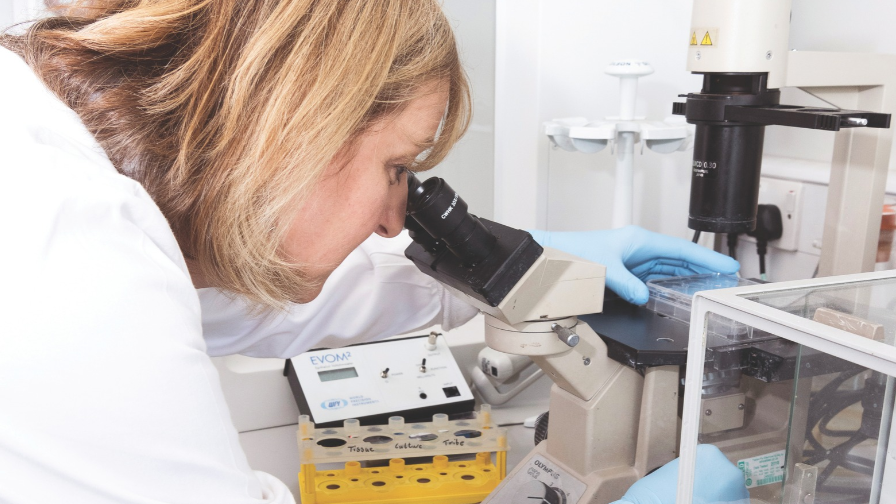
Borne and Action Medical Research spotlight research led by Professor Rachel Tribe and Dr Natalie Suff as they mark 10 years of jointly funding research into premature birth.
As World Prematurity Day (15 November) approaches, Borne and Action Medical Research are highlighting the impact of research they have jointly funded over the last decade to improve understanding of premature birth and help give more babies the best possible start in life.
A programme of research led by Professor Rachel Tribe and Dr Natalie Suff at St Thomas’ Hospital and King’s College London has helped build understanding of why preterm birth occurs and identified promising new approaches to predict and prevent it.
Action Medical Research and Borne have funded two projects, to the value of £332,359, led by Professor Rachel Tribe and her group at St Thomas’ Hospital and King’s College London. The two completed projects are part of a programme of research that has helped build understanding of why preterm birth occurs and identified promising new approaches to predict and prevent it. Together, they have provided the foundations for a new follow-on study aimed at moving a potential therapy closer to clinical use.
Preterm birth, which occurs when a baby is born before 37 weeks of pregnancy, affects around 55,000 babies in the UK every year and tragically around 1,000 babies die each year as a result. Babies who survive can face lifelong health challenges, including cerebral palsy, learning difficulties, blindness and hearing loss. Despite its significant impact on families, predicting which pregnancies are at greatest risk and preventing spontaneous preterm birth remain major challenges.
Professor Rachel Tribe (pictured below), Dr Natalie Suff and their team at King's College London have been investigating the biological processes that contribute to preterm birth, with a particular focus on the role of inflammation and the body's immune response during pregnancy. Their research aims both to identify women at increased risk of early labour and to develop new treatments that could prevent babies from being born too soon.

From predicting premature birth…
The first project, funded in 2018, explored whether tiny particles naturally released by cells lining the vagina, known as small extracellular vesicles (sEVs), could provide early warning signs of preterm birth.
These microscopic particles carry biological messages between cells and may reflect changes occurring during pregnancy. The researchers developed new methods to isolate and analyse sEVs from cervical swab samples collected during pregnancy and carried out a pilot study to investigate whether women who later experienced preterm birth showed different sEV patterns in early pregnancy.
The long-term goal is to create a simple screening test that could help identify women at increased risk of preterm birth early in pregnancy, allowing closer monitoring and earlier intervention.
The funding provided through the initial study enabled the team to establish new techniques and collaborations in the field of research aimed at preventing premature birth. The project identified several promising biological signals that may differ between pregnancies ending in preterm and full-term birth, providing an important proof of concept for future studies investigating new screening approaches.
…to developing new ways to prevent it
The second project funded in 2022, focused on prevention rather than prediction.
Building on growing evidence that inflammation in the uterus, placenta and other maternal tissues can trigger preterm labour, the researchers investigated a novel cell-based therapy using specialised human decidual stromal cells (hDSCs). These cells normally help regulate the mother's immune system during pregnancy, enabling her body to support the developing baby.
Working with collaborators in Sweden, the team tested whether administering hDSCs could reduce harmful inflammation and delay delivery in laboratory models of preterm birth. This innovative approach sought to harness the body's natural mechanisms for maintaining a healthy pregnancy and could potentially provide a new treatment option for women at high risk of spontaneous preterm birth.
The second study generated encouraging evidence that hDSC therapy can delay delivery in a laboratory model of preterm birth, supporting the idea that targeting immune and inflammatory pathways may offer a new way to prevent babies from being born too soon.
The findings provided valuable information about the biological mechanisms involved and highlighted important areas for further investigation.
Moving a potential therapy closer to clinical trials
Together, these projects have strengthened scientific understanding of preterm birth and created a platform for further research aimed at developing treatments ready for use in the clinic.
As a direct result of the advances made, Professor Tribe and Dr Suff and their team secured Borne and Action funding for a third project in 2025. This new study will further evaluate hDSC therapy in several laboratory models of preterm birth, including those driven by inflammation and infection.
The researchers will investigate how the treatment affects inflammation in both mother and baby, determine the most effective dose and timing of treatment, and assess its potential to improve survival of babies and reduce complications associated with preterm birth.
The aim is to generate the evidence needed to move this promising cell therapy closer to future clinical trials in women at high risk of spontaneous preterm birth, with the aim of improving outcomes for babies in the UK and beyond.
The impact of the funding has also extended beyond the individual projects. Action-Borne funding has also been instrumental in supporting Dr Suff's clinical academic career trajectory. The charity's investment provided critical support at a formative stage of her development as an independent researcher, enabling her to build her research portfolio.
Through facilitating the generation of preliminary data, the development of innovative research ideas, and the establishment of national and international collaborations, Action-Borne helped position Natalie to compete successfully for major external funding. This includes her Wellcome Clinical Research Career Development Fellowship and being chosen by competitive KCL triage to apply for the UKRI Future Leaders Fellowship scheme.
David Badcock, Chief Executive of Borne, said: "This programme of research captures exactly what sustained investment in science can achieve. What began with trying to understand how we might identify pregnancies at risk has developed into research exploring a potential new way to prevent premature birth. The early findings from Professor Tribe, Dr Suff and their team are encouraging, but the next stage is critical. We need the rigorous evidence that can tell us whether promising approaches in the laboratory have the potential to become safe and effective treatments for women. Through our partnership with Action Medical Research, we have been able to support that progression over a number of years; building knowledge, investing in talented researchers and allowing promising discoveries to move forward. It is this long-term commitment that gives us the best chance of turning scientific discovery into meaningful change for babies and families.”
Dr Douglas Graham, Chief Executive at Action Medical Research, said: “For families, the consequences of premature birth can last a lifetime. Research to change that takes time, and promising ideas need sustained support if they are to progress towards new treatments. By investing over the years, we are helping researchers build on what they learn, develop their expertise and generate the evidence needed to take the next step. We’re proud that our joint funding has helped lay the foundations for this work, and grateful to our supporters for making it possible.”