
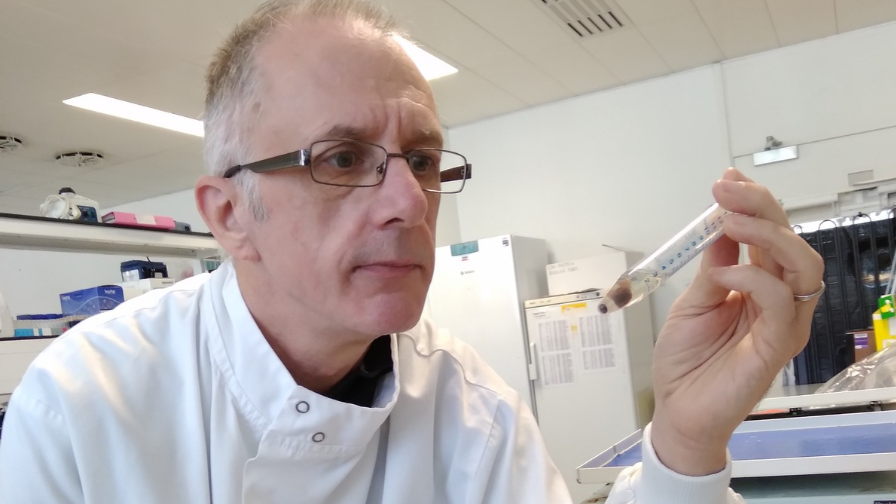
Borne and Action Medical Research spotlight research led by Professor Michael Taggart as they mark 10 years of jointly funding research into premature birth.
As part of World Prematurity Day (15 November), Borne and Action Medical Research are highlighting the impact of research they have jointly funded over the last decade to improve understanding of premature birth and help give more babies the best possible start in life.
Funding of nearly £200,000 from Action Medical Research and Borne has enabled Professor Michael Taggart at Newcastle University, along with colleagues in Belfast, to use novel techniques to determine, for the first time, the specific molecular differences between tissues in the womb and blood vessels in the womb and placenta. This work has put researchers in a strong position to design new drugs, or repurpose existing ones, to prevent premature labour, representing an important step towards saving babies' lives.
Preterm birth, where a baby is born before 37 weeks of pregnancy, affects around 55,000 babies in the UK each year, and tragically around 1,000 babies die each year as a result. Babies who survive can face long-term health challenges, including learning difficulties, cerebral palsy, hearing loss and visual impairment.
A common cause of preterm birth is spontaneous early labour, when the muscles of the womb begin contracting too soon. Although drugs exist that can reduce these contractions, they can also affect blood vessels in the uterus and placenta, potentially reducing blood flow to the baby and causing unwanted side effects. Safer and more targeted treatments are urgently needed.
“We urgently need to develop safer, more effective treatments that can help stop premature labour,” says Professor Taggart. “Importantly, we need to make sure that these don’t expose the mother or baby to the risk of potentially serious side effects.”
Mapping the molecular differences
This project aimed to improve understanding of how the muscles of the womb differ from the blood vessels in the womb and placenta at a molecular level. The goal was to identify subtle biological differences between tissues, particularly in their ability to contract and relax, that could eventually be used to develop drugs that specifically relax the womb without affecting blood vessels in the womb and placenta.
Researchers collected samples from pregnant women undergoing planned caesarean sections (C-sections) and studied three key tissues: the muscles of the womb (myometrium), blood vessels in the womb and blood vessels in the placenta.
Using advanced laboratory techniques, the team analysed almost 7,000 proteins and 20,000 genes within these tissues. They also examined specific types of cells found across all three tissues, as well as cells found only in particular tissues, known as tissue-specific cells. The aim was to understand which cell types were responsible for the differences observed between tissues.
This research provided one of the most detailed molecular maps yet created for these parts of the womb and placenta, alongside new knowledge of molecular pathways that differ between womb muscle and blood vessels in the womb and placenta.
Identifying potential targets for future treatments
The funding has enabled researchers to significantly advance understanding of the biological processes that control womb contraction.
The team identified more than 2,000 proteins and over 6,000 genes that were expressed differently across the three tissue types studied: womb muscle, blood vessels in the womb and blood vessels in the placenta.
The researchers discovered distinct molecular signatures – unique molecular characteristics – that distinguish womb muscle from blood vessels in both the womb and placenta. They also identified specific cell populations that contribute to these differences and, for the first time, integrated these findings to explain why the three tissues behave differently.
Importantly, the work has highlighted new biological pathways and potential drug targets that could be explored in the future.
These findings provide a strong foundation for developing new medicines, or repurposing existing ones, that may be able to safely prevent premature labour by acting specifically on womb muscle while avoiding harmful effects on maternal or placental blood vessels.
Generating valuable new knowledge
The research funded by the Borne and Action Medical Research partnership has delivered substantial outputs and generated valuable new knowledge for the field. The project also contributed expertise and methods that supported wider collaborative research initiatives investigating the biology of labour and pregnancy complications.
Researchers at Imperial College London, King's College London and Newcastle University have worked collaboratively to map the characteristics of cells from different areas within the womb and at different stages in labour, accelerating progress towards preventing preterm birth and improving outcomes for more parents and babies.
The findings have been presented at national and international scientific meetings and are being prepared for publication. Researchers estimate that the knowledge generated by this work could contribute to clinical advances within the next five years.
Overall, this research has accelerated progress towards the long-term goal of developing safer and more effective treatments to prevent preterm birth and improve outcomes for babies and their families.
David Badcock, Chief Executive of Borne, said: “Stopping premature labour is not simply a question of stopping the womb from contracting. Any treatment also needs to be safe for both mother and baby, which is why understanding these incredibly complex biological differences matters. Professor Taggart and his colleagues have given researchers a much more detailed picture of what makes the muscle of the womb different from the blood vessels that support pregnancy. That knowledge opens up new possibilities for developing treatments that can target the womb more precisely, without causing unwanted effects elsewhere.
"This is exactly why sustained investment in discovery research is so important. Through our partnership with Action Medical Research, we can fund the fundamental science that builds the foundations for future treatments and move closer to a world where we can safely intervene to prevent babies from being born too soon.”
Dr Douglas Graham, Chief Executive at Action Medical Research, said: “We urgently need better ways to prevent babies being born too soon, without putting mothers or babies at risk and this research is an important step towards identifying safer, more targeted treatments. As we mark 10 years of partnership with Borne, we’re grateful to the supporters who make this vital research possible and help us work towards a healthier start in life for more babies.”