
Barnaby's story
Epilepsy
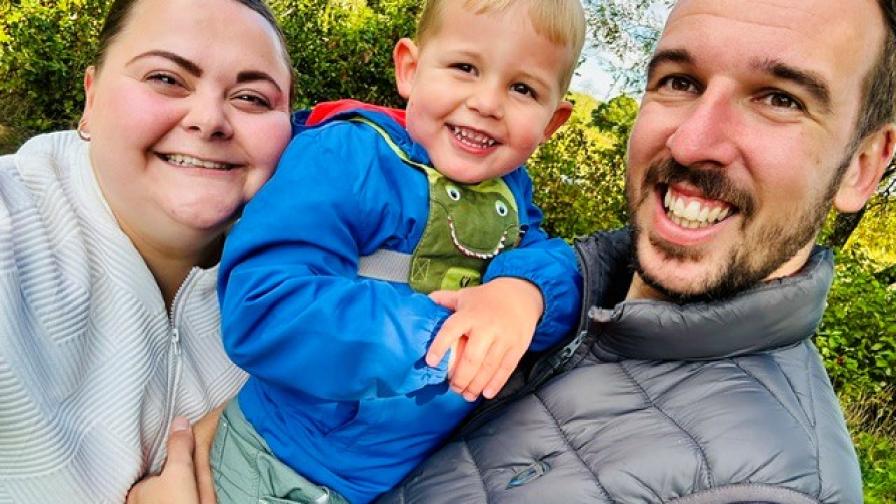
Barnaby had seemed a happy, healthy baby, but when he was around five weeks old, his parents, Charlotte and Kieran, began to notice quick, unusual eye movements when he woke up or was sleepy. A few weeks later, he experienced an episode so frightening they took him straight to hospital. That morning, just after waking, Barnaby had a series of back-to-back seizures. “They looked so severe, and he started crying out of them,” recalls Charlotte.
Barnaby was diagnosed with infantile spasms, a form of epilepsy that begins within the first years of life. He began medication straight away and it initially seemed to work. He seemed to be developing well and began to say his first words. But within six months, the spasms returned with a vengeance – and he began to have atonic drop seizures. These would cause a sudden loss of muscle tone, making him go limp and fall.
Barnaby also began to regress in his skills: “He could no longer say ‘mama’ or wave and point. It just vanished,” says Charlotte. The family would later find out that Barnaby’s seizures caused damage to his brain, affecting his memory.
MRI scans eventually revealed that Barnaby had Focal Cortical Dysplasia (FCD) in his left frontal lobe. This was an area of his brain that had not formed properly. The location of the FCD also affected Barnaby’s balance and mobility.
Keeping Barnaby stable required five different medicines, twice a day, plus a sedative so he could sleep at night. Yet this only reduced his seizure activity to around 30-50 a day. He also needed emergency medicines to use when an episode of seizures continued beyond a certain time-frame – the duration of which was repeatedly extended.
In the long term, the medications Barnaby needed came with the risk of very serious side effects, including sight, heart, kidney or liver damage.
We were on the maximum doses of everything. There was no room left for tailoring or reducing Barnaby's medications”
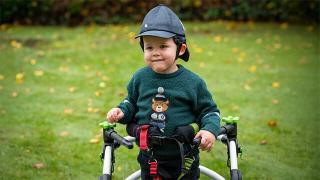
As a toddler, Barnaby’s seizures caused regular injuries. “He chipped his tooth, split his lips multiple times,” says Charlotte. “We padded our home as much as possible and he slept in a 'safe space bed'. He wore a protective helmet most of the day and used a walker frame out and about,” says Charlotte.
Ultimately, brain surgery was the only hope of ever fully gaining control of Barnaby’s seizures.
When Barnaby was a baby, he took part in research that followed children with early-onset epilepsy – work that Action funding is helping to continue in children aged three to five.
With epilepsy a key focus for the charity, Action is currently funding eight different studies in this area – as well as further research to help children affected by rare diseases, in which epilepsy is also often involved.
Charlotte says: “I hope that research can get us to a point where other families never have to go through what we have. Barnaby was the happiest and most resilient little boy. He was never defined by his medical needs or challenges. He had a lovely way of bringing people together, of making people kinder, softer, more compassionate, inclusive and more grateful for the little milestones.”
Barnaby had the most beautiful spirit. His smile lit up every room and his presence made our lives complete. Even after his death, he is continuing to help others with vital research. We will continue to fight in his name forever so no parent will ever have to face this heartache.”
Barnaby was featured on BBC South Today 26 March 2026